Innovation, Quantum-AI Technology & Law

Blog over Kunstmatige Intelligentie, Quantum, Deep Learning, Blockchain en Big Data Law

Blog over juridische, sociale, ethische en policy aspecten van Kunstmatige Intelligentie, Quantum Computing, Sensing & Communication, Augmented Reality en Robotica, Big Data Wetgeving en Machine Learning Regelgeving. Kennisartikelen inzake de EU AI Act, de Data Governance Act, cloud computing, algoritmes, privacy, virtual reality, blockchain, robotlaw, smart contracts, informatierecht, ICT contracten, online platforms, apps en tools. Europese regels, auteursrecht, chipsrecht, databankrechten en juridische diensten AI recht.

Stanford Responsible Quantum Technology Conference 2023

Stanford, CA – May 22, 2023 – The 21st century is undeniably the Quantum Age, and on May 22, 2023, Stanford University hosted the inaugural Stanford Responsible Quantum Technology Conference at the iconic Paul Brest Hall, Stanford Law School. This landmark annual event, themed "Quantum-ELSPI" for its first iteration, brought together the global quantum community to explore the multifaceted ethical, legal, socio-economic, and policy implications (ELSPI) of this transformative field.

The conference was designed as a unique confluence of quantum physics, law, and art, aiming to discuss informed suggestions on how to balance maximizing the benefits and mitigating the risks of applied quantum technology. It covered state-of-the-art quantum computing, sensing, simulation, communication, materials, and quantum-classical hybrids, all within diverse multidisciplinary settings and taking a pro-innovation stance.

A Day of Interdisciplinary Exploration and Artistic Inspiration

The day was marked by deeply interdisciplinary presentations and an elegant intellectual atmosphere, uniquely punctuated by live musical interludes featuring works by Mozart, Schönberg, and Chopin, and opera arias by Handel, Liszt, and Gounod. Attendees also witnessed interactive quantum physics experiments, including demonstrations of quantum sensing and interferometry, designed to make the counter-intuitive quantum world more accessible.

The program began with Opening Remarks by Mauritz Kop of Stanford University, AIRecht.nl, and Daiki. This set the stage for a day of profound discussions.

What Responsible Quantum Technology & Innovation Entails

As attendees experienced, the conference provided an illuminating platform for discussing the state-of-the-art in quantum science, governance tipping points, risk-benefit analyses, intellectual property, societal impact assessments, and the myriad exciting novel use cases being developed. The discussions on what Responsible Quantum Technology & Innovation truly entails in diverse, multidisciplinary, and intergenerational settings were a highlight for all participants.

Mauritz Kop offered closing remarks, and the day concluded with a reception, further fostering the sense of community and shared purpose.

Deep gratitude was extended to all the speakers, moderators, musicians (Ireh Kim, Jin-Hee Catherine Lee, Zoe Logan Schramm, Katie Liu, Daniel Changxiao Sun, and Mauritz Kop), and physicists (Franz Inthisone Pfanner, Daniel Changxiao Sun) who contributed to the success of this inaugural event. Special thanks were also conveyed to Professor Mark Lemley and the team at Stanford Law School for making this memorable conference a reality.

The Stanford Responsible Quantum Technology Conference has set a high bar for future discussions, and the quantum community eagerly anticipates Stanford RQT 2.0.

Meer lezen
Fortune Publication: How to Prevent Quantum-A.I. Hybrids from Taking Over the World

Palo Alto, May 16, 2023—We are delighted to share our new Fortune piece titled "How to prevent quantum-A.I. hybrids from taking over the world," that showcases our Stanford-led research on Responsible Quantum Technology! The 21st century is rapidly becoming the Quantum Age. While the full realization of general-purpose quantum computers is still on the horizon, the emergence of hybrid systems that combine quantum phenomena with classical hardware is already a reality, making its way into both domestic and international markets. This convergence of quantum technology and artificial intelligence (AI) promises to unlock unprecedented advancements across various fields, but it also presents a host of complex geopolitical and grand strategy challenges that demand our immediate attention. As we stand on the precipice of this technological revolution, it is imperative that we proceed with a strong sense of responsibility, ensuring that these powerful tools are developed and deployed in a manner that aligns with our most cherished societal values.

Critical Quantum Insights for a Business Audience

The article, "How to prevent quantum-A.I. hybrids from taking over the world," published in Fortune on May 16, 2023, delves into the profound implications of this technological convergence, offering critical quantum insights for a business audience. It highlights the stark contrast between the development of quantum technology (QT) in liberal democracies, where adherence to fundamental human rights and democratic values is paramount, and its potential applications in autocratic regimes that may wield it for more nefarious purposes. The piece underscores the existential importance of international collaboration, not only on pressing global issues like climate change and inequality but also in the race for technological dominance, where the preservation of freedom and democratic principles hangs in the balance. As quantum-AI hybrids become increasingly prevalent, the authors argue that business and government leaders must engage with experts and the public to establish robust ethical standards, accountability mechanisms, and responsible technology frameworks to actively foster a competitive, values-based quantum-AI ecosystem.

In 2022, Kop & Wadhwa wrote a Foreign Policy paper titled ‘Why Quantum Computing Is Even More Dangerous Than Artificial Intelligence’, see: https://airecht.nl/blog/2022/why-quantum-computing-is-even-more-dangerous-than-artificial-intelligence-foreign-policy

The Dawn of the Quantum-AI Era: Navigating Opportunities and Risks

At the heart of this discourse is the recognition that any major technological advance inevitably raises critical questions of justice, benefit, and risk. The sheer scale and rapid pace of QT-enabled advancements, coupled with their counterintuitive nature, make these considerations all the more urgent. The potential applications are vast and transformative, ranging from quantum chemistry and drug design to logistical optimization and clean energy. However, the threats are equally significant, with the most widely understood being the imminent danger that quantum computing poses to our current cybersecurity infrastructure and data privacy.

In response to these challenges, a global conversation is underway among stakeholders to find a delicate balance between harnessing the benefits of QT and mitigating its risks. Many are turning to the established principles of Responsible Research and Innovation (RRI), which emphasize the importance of responsiveness, inclusivity, reflexivity, and anticipation. RRI posits that scientific and technological breakthroughs should be guided not only by scientific brilliance and economic incentives but also by social norms, ethical values, environmental sustainability, and public engagement. This approach encourages the integration of societal concerns throughout the entire innovation lifecycle, from the initial stages of research and development to the eventual distribution and use of new technologies.

A Framework for Responsible Quantum Innovation: The RQT Approach

Building upon this foundation, a Stanford-led interdisciplinary research group, comprising scholars from law, data science, theoretical physics, philosophy, ethics, social sciences, materials science, and innovation policy, has conceptualized a novel framework known as Responsible Quantum Technology (RQT). This framework is designed to proactively steward the development of QT toward equitable outcomes, mitigate potential risks, and foster an interdisciplinary approach to research and development. RQT embeds the key principles of RRI alongside a comprehensive consideration of the ethical, legal, socio-economic, and policy implications, collectively referred to as Quantum-ELSPI. The ultimate goal of RQT is to ensure that research and innovation efforts are aligned with societal expectations and contribute to the enhancement of planetary welfare.

Meer lezen
Quantum Technology Impact Assessment (EU AI Alliance, European Commission)

Brussels, 20 April 2023—The emergence of powerful new capabilities in large AI models, such as Generative Adversarial Networks (GANs), underscores the critical need to continuously improve and update technology impact assessment tools, ensuring they keep pace with rapid technological development. As defined in recent scholarship, technology impact assessment is the systematic process of monitoring and determining the unintended, indirect, or delayed societal impacts of a future technological innovation. Crucially, it is also about capitalizing on opportunities and enabling responsible innovation from the outset.

An article by Stanford Law’s Mauritz Kop on this topic is also featured on the European Commission's Futurium website.

Shaping the Quantum Innovation Process

Quantum Impact Assessments (QIAs) are emerging as vital practical tools to facilitate the responsible adoption of quantum technologies. There are several related approaches to this assessment: (1) interactive QIA, which seeks to influence and shape the innovation process; (2) constructive QIA, where social issues guide the design of the technology from its earliest stages; and (3) real-time QIA, which connects scientific R&D with social sciences and policy from the start, before a technology becomes locked-in.

Often taking the form of codes of conduct, best practices, roadmaps, and physics de-risking tools, QIA instruments can be used by governments, industry, and academia. These soft law toolsallow stakeholders to explore how current technological developments affect the world we live in and to proactively shape the innovation process toward beneficial, societally robust outcomes.

Exploratory Quantum Technology Assessment

Implementing interdisciplinary, expert-based QIAs can help raise awareness about the ethical, legal, socio-economic, and policy (ELSPI) dimensions of quantum technology, including quantum-classical hybrid systems. For instance, QIAs cultivate a deeper understanding of the potential dual-use character of quantum technology, where beneficial applications (such as quantum sensing for medical diagnostics) can exist alongside potentially harmful ones (such as the same sensors being used for autocratic surveillance).

Building on the foundational work of the 2018 AI Impact Assessment developed by ECP | Platform voor de InformatieSamenleving chaired by Prof. Kees Stuurman, this work presents a prototype of a QIA instrument: the Exploratory Quantum Technology Assessment (EQTA). This pioneering initiative was made possible through a collaboration between the Dutch Ministry of Economic Affairs & Climate Policy, Quantum Delta NL (QDNL), and ECP. The EQTA will be presented by Eline de Jong and Mauritz Kop at the inaugural Stanford Responsible Quantum Technology Conference in May 2023.

Guidance for Responsible Quantum Technology Implementation

The EQTA provides a comprehensive, practical step-by-step plan that encourages stakeholders to initiate a dialogue to clarify which ethical, legal, and social aspects are important in the creation and application of quantum systems and their interaction with classical technologies. This structured approach helps make the use of quantum technology—as well as the data and algorithms that power it—more transparent and accountable from an early stage.

Looking forward, establishing a risk-based legal-ethical framework in combination with standardization, certification, technology impact assessment, and life-cycle auditing of quantum-driven systems is crucial to stewarding society towards responsible quantum innovation. Mauritz Kop’s research group has written more on this framework in their seminal article Towards Responsible Quantum Technology (Harvard).

Meer lezen
Towards Responsible Quantum Technology published by Harvard Berkman Klein Center for Internet & Society

Boston, MA, March 21, 2023—In a landmark contribution to the global dialogue on technology governance, the Harvard Berkman Klein Center for Internet & Society has published the foundational article, "Towards Responsible Quantum Technology." This significant work, the result of a deeply interdisciplinary and transatlantic collaboration, lays out a comprehensive conceptual framework for steering the development of quantum technologies (QT) in a direction that is safe, ethical, and aligned with democratic values.

The manuscript, which was also published in the Hastings Science & Technology Law Journal by the University of California, College of the Law, San Francisco, and in the University of Cambridge repository -with preprints at Stanford Law, ArxiV and the European Commission’s Futurium website- represents a concerted effort to get ahead of the regulatory curve. It argues for a proactive, principled approach to governance while the technology is still malleable, learning from the often-reactive postures taken with previous technological waves like AI and the internet.

A Transatlantic Constellation of Scholars

The paper is authored by a distinguished group of international scholars led by Mauritz Kop, Visiting ‘Quantum & Law’ Scholar at Stanford and the imminent Founding Director of the Stanford Center for Responsible Quantum Technology. The team represents a formidable convergence of expertise from the world's leading academic institutions, including Stanford, Harvard, Oxford, Yale, Cambridge, the University of Waterloo, and the Universities of Munich, Amsterdam, Maastricht, and Copenhagen.

This collaboration brought together leading lights in law, data science, theoretical quantum physics, philosophy and ethics, socioeconomics, materials science and engineering, and innovation policy. The author group includes Mateo Aboy, Eline De Jong, Urs Gasser, I. Glenn Cohen, Timo Minssen, Teresa Quintel, Mark Brongersma, Luciano Floridi, and Raymond Laflamme, whose collective insights provide a holistic and robust foundation for the proposed framework.

The RQT Framework: Integrating Quantum-ELSPI and RRI

At the heart of the paper is the conceptual framework for Responsible Quantum Technology (RQT). This framework is designed to systematically integrate considerations of the Ethical, Legal, Social, and Policy Implications (ELSPI) of quantum technologies directly into the research and development lifecycle.

The RQT framework is built upon the established dimensions of Responsible Research and Innovation (RRI)—anticipation, inclusion, reflection, and responsiveness. By merging these two approaches, Quantum-ELSPI and RRI, the authors have created a powerful tool for ensuring that the development of quantum is not driven solely by technical or commercial imperatives, but by a deep and abiding commitment to societal well-being.

Operationalizing Responsible Quantum Technology: The 10 Principles and Future Regulation

The "Towards Responsible Quantum Technology" paper is the first in a series of studies designed to build a comprehensive governance architecture. It lays the conceptual groundwork that is further operationalized in a subsequent study led by Kop, the "10 Principles for Responsible Quantum Innovation." This second paper translates the high-level SEA framework into concrete, actionable principles for real-world application.

Ultimately, the RQT framework is intended to inform the emergent regulatory landscape for quantum technology. The authors provide an outlook on how regulatory interventions can be designed and contextualized to be effective without stifling innovation. By tailoring governance to the exceptional nature of quantum, the goal is to reduce the risk of unintended, counterproductive policy effects and to foster a thriving, responsible, and values-based quantum ecosystem. The paper concludes with a call to action for the research community and other stakeholders to build upon this foundational work, to further develop the guiding principles, and to translate them into the best practices that will define the quantum future.

Meer lezen
Mauritz Kop Speaks on Quantum Ethics, Intellectual Property and Innovation at NASA SWEEEP Event

On October 3, 2022, a interdisciplinary dialogue on the future of quantum technology and its societal implications took place within a consortium focused on some of the most pressing environmental challenges of our time. Mauritz Kop, a visiting quantum and law scholar at Stanford University, was invited to address a workshop for the SouthWest Engine for Environment and Economic Prosperity (SWEEEP), a major initiative led by a consortium including NASA’s Jet Propulsion Laboratory (JPL), CalTech, and California State University, Northridge. The event, part of the National Science Foundation (NSF) Regional Innovation Engines program, provided a platform to discuss the intricate web of ethical, legal, socio-economic, and policy implications—termed "Quantum-ELSPI"—that must be navigated as quantum technologies are harnessed to address grand challenges like water scarcity and agricultural sustainability.

The Institutional Context: NASA and the SWEEEP Mission

The National Aeronautics and Space Administration (NASA), established in 1958, has a storied history of pushing the boundaries of science and technology for the benefit of humanity. While renowned for space exploration, its mission extends deeply into Earth science, utilizing its unique vantage point from space to understand and protect our home planet. From monitoring climate change and weather patterns to managing natural resources, NASA’s work is foundational to global environmental stewardship.

This commitment to terrestrial challenges is exemplified by its involvement in the SWEEEP initiative. SWEEEP is a direct response to the NSF Regional Innovation Engines program, a nationwide effort to catalyze and accelerate regional-scale, R&D-based innovation ecosystems. The program is designed to fund "Engines" that advance critical technologies, address societal challenges, promote economic growth, and cultivate regional talent, with potential funding of up to $160 million over ten years per Engine.

It was within this context of ambitious technological solution-building that Mauritz Kop was invited to provide a crucial perspective on governance and responsible innovation. The leaders of the initiative, including Edward Chow of NASA JPL and Bingbing Li of California State University Northridge, recognized that developing powerful new technologies carries a responsibility to proactively address their societal impact.

Quantum-ELSPI: A Framework for Responsible Innovation

In his address, Mauritz Kop introduced the comprehensive concept of Quantum-ELSPI, arguing for a multidisciplinary approach that integrates ethical, legal, socio-economic, and policy considerations directly into the R&D lifecycle. He stressed the importance of "building bridges between disciplines," enabling quantum physicists and engineers to communicate effectively with experts in the humanities and social sciences. The goal is not to give premature, all-encompassing answers, but to begin by asking the right questions.

For a project like SWEEEP, this means looking beyond the technical specifications of a quantum sensor to consider the legal frameworks for the data it collects, the ethical implications of its use in agriculture, and the socio-economic impact on farming communities. Kop noted that NSF reviewers would likely value such a forward-thinking awareness of the complex societal dimensions of the proposed technological interventions.

Intellectual Property in the Quantum Age: Fostering or Hindering Innovation?

A significant portion of the discussion was dedicated to the role of intellectual property (IP) in the quantum domain. Quantum computers and related systems are extraordinarily complex, comprising myriad components, each potentially protected by its own IP right. Kop described this as a "rainbow of IP rights," where patents, copyrights, trade secrets, and trademarks can create a dense and overlapping landscape.

While IP is designed to incentivize invention, he cautioned that an over-reliance on exclusive rights could lead to "IP overprotection," potentially stifling the cumulative, follow-on innovation that is essential for a burgeoning field like quantum technology. The challenge is to balance the need to protect inventions with the goal of building an open, thriving global quantum ecosystem.

Meer lezen
Why Quantum Computing Is Even More Dangerous Than Artificial Intelligence (Foreign Policy)

Washington DC, August 21, 2022. Foreign Policy just published an article about regulating quantum technology authored by Vivek Wadhwa and Mauritz Kop. https://foreignpolicy.com/2022/08/21/quantum-computing-artificial-intelligence-ai-technology-regulation/

United States and other democratic nations must prepare for tomorrow's quantum era today

To avoid the ethical problems that went so horribly wrong with AI and machine learning, democratic nations need to institute controls that both correspond to the predicted power of the emerging suite of second generation quantum technologies, and respect & reinforce democratic values, human rights, and fundamental freedoms. In fact, the quantum community itself has issued a call for action to immediately address these matters. We argue that governments must urgently begin to think about regulation, standards, and responsible use—and learn from the way countries handled or mishandled other revolutionary technologies, including AI, nanotechnology, biotechnology, semiconductors, and nuclear fission. Benefits and increased quantum driven prosperity should be equitably shared among members of society, and risks equally distributed. The United States and other democratic nations must not make the same mistake they made with AI—and prepare for tomorrow's quantum era today.

Meer lezen
Intellectual Property in Quantum Computing and Market Power: A Theoretical Discussion and Empirical Analysis (Oxford University Press)

Delighted to see our article ‘Intellectual Property in Quantum Computing and Market Power: A Theoretical Discussion and Empirical Analysis’ -co-authored with my talented friends Prof. Mateo Aboy, PhD, SJD, FIT and Prof. Timo Minssen- published in the Journal of Intellectual Property Law & Practice (Oxford University Press), the flagship IP peer-reviewed OUP Journal, edited by Prof. Eleonora Rosati. Thanks to the JIPLP team for excellent editorial support! Our article: https://academic.oup.com/jiplp/article/17/8/613/6646536

This piece is the sisterpaper of our Max Planck @ Springer Nature published article titled ‘Mapping the Patent Landscape of Quantum Technologies: Patenting Trends, Innovation and Policy Implications’, which we wrote in parallel. The IIC quantum-patent study can be found here: https://link.springer.com/article/10.1007/s40319-022-01209-3. Our teamwork was absolutely gratifying and we hope it will inform strategic, evidence based transatlantic policy making.

IP and Antitrust Law

Please find a short synopsis of our work below:

We are on the verge of a technological revolution associated with quantum technologies, including quantum computing and quantum/artificial intelligence hybrids. Its complexity and global significance are creating potential innovation distortions, which could not have been foreseen when current IP and antitrust systems where developed.

Potential IP Overprotection

Using quantitative methods, we investigated our hypothesis that IP overprotection requires a reform of existing IP regimes for quantum tech, to avoid or repair IP thickets, fragmented exclusionary rights and anticommons concerns, lost opportunity costs, and an unwanted concentration of market power.

Perhaps counter-intuitively, we found that there appear to be (at least so far) no such overprotection problems in the real-world quantum computing field to the extent that their consequences would hinder exponential innovation in this specific branch of applied quantum technology, as more and more quantum patent information enters the public domain.

Patents versus Trade Secrets and State Secrets

However, developments taking place in secrecy, either by trade secrets or state secrets, remains the Achilles heel of our empirical approach, as information about these innovations is not represented by our dataset, and thus cannot be observed, replicated or generalized.

Interplay between IP and Antitrust Law: Open or Closed Innovation Systems

Policy makers should urgently answer questions regarding pushing for open or closed innovation systems including the interplay between IP and antitrust law, taking into account dilemma’s pertaining to equal/equitable access to benefits, risk control, ethics, and overall societal impact. Crucially, intellectual property in quantum technology has a national safety and (cyber)security dimension, often beyond the IP toolkit.

Meer lezen
Mauritz Kop calls for a Quantum Governance Act at the University of Copenhagen, Faculty of Law

Much enjoyed giving a lecture titled ‘Quantum-ELSPI: A Call for a Quantum Governance Act’ on Thursday June 9, 2022 at the University of Copenhagen, Faculty of Law. This was an internal CeBiL event that took place before The Quantum Future symposium, organized by the Royal Danish Academy of Sciences and its newly established Committee for Quantum Information and Quantum Computing, together with the Niels Bohr Institute’s Quantum Life Centre.

EU Quantum Governance Act

With its own Copenhagen interpretation of quantum mechanics in which physical phenomena must be observed and measured to exist, the University of Copenhagen, Faculty of Law was the perfect place to propose an outline for a novel Quantum Governance Act on a European level, fostering open innovation while putting targeted, technology and industry specific risk based controls in place. The EU Quantum Act should jointly optimize advancing quantum technology (investment and innovation) with safeguaring quantum technology, society and humankind (guardrails, standards, values, IP protection and national security). For example, it could contain a product safety regime as found in the EU AI Act, combined with pro-innovation mechanisms as found in the US CHIPS Act. In addition, I connected regulating quantum to regulating general purpose technologies (GPT) like artificial intelligence (AI), but also to nanotechnology, biotechnology, semiconductors, and last not least to managing dual use fissionable materials such as nuclear isotopes and nuclear weapons, utilizing export and intellectual property controls.

The Law of Quantum: Quantum Regulatory Frameworks

The Quantum & Law lecture gave an overview of work done over the past 3 years on quantum regulatory frameworks, incentive and rewards systems, competition law, beyond intellectual property innovation law, ethics, national security policy, standardization, technology impact assessment, benchmarking and certification published or forthcoming in high impact journals at both sides of the Atlantic. My talk ended with discussing the latest research findings pertaining to the Law of Quantum, and Quantum-ELSPI academic disciplines. Thanks to the participants for their inspiring questions and comments!

Panel Debate about the Quantum Future at the Royal Danish Academy of Sciences

The brilliant lectures on atoms, photons, qubits, the nature of quantum information, the history of quantum physics, and current research into quantum computer paradigms -including combatting decoherence on both software and hardware levels- at The Quantum Future symposium where highly enjoyable. This fascinating program ended with a panel debate on how quantum technology will change our society, at the beautiful building of the Royal Danish Academy of Sciences, in attendance of fellow jurists Nicholson Price II, Louise C. Druedahl, Marcelo Corrales Compagnucci, and Agnieszka Radziwon.

Surfing the Waves of the Second Quantum Revolution

The panel debate at the Academy -superbly moderated by Nanna Bonde Thylstrup- gave a true, almost symptomatic picture of the various stakeholders' viewpoints and positions. But we are learning to speak each other's language better and better, a crucial and exciting step when it comes to balancing the societal impact of our mystical family of quantum technologies. Surfing the waves of the second quantum revolution requires building bridges between disciplines, beyond traditional research silos. Bringing together the humanities, social and natural sciences to spur sustainable innovation driven by a golden triangle of academia, government and industry is essential.

Thank you to Professor Timo Minssen and his team at CeBiL for the kind invite. https://jura.ku.dk/cebil/

Meer lezen
Mauritz Kop joins Expert Panel on Quantum Technologies of the Council of Canadian Academies (CCA)

Mauritz Kop joins the multidisciplinary Expert Panel on Quantum Technologies of the Council of Canadian Academies (CCA) over 2022-2023, chaired by Professor Raymond Laflamme. In November 2023, The Expert Panel on the Responsible Adoption of Quantum Technologies published their final report titled Quantum Potential. https://cca-reports.ca/reports/quantum-technologies/

The Council of Canadian Academies (CCA) Investigates Future Impact of Quantum Technologies

As Chair, Dr. Raymond Laflamme will lead a multidisciplinary group with expertise in quantum technologies, economics, innovation, ethics, and legal and regulatory frameworks. The Panel will answer the following question:

In light of current trends affecting the evolution of quantum technologies, what opportunities and challenges do these present in Canada?

The Quantum Potential Report

Quantum technologies are poised to play a major role in Canada’s future, from its national security to its economic standing. While Canada is among the global leaders in quantum research, it nevertheless faces challenges in the adoption of these technologies as they approach market readiness. Quantum Potential, a new expert panel report from the Council of Canadian Academies (CCA), outlines a responsible approach to quantum-technology adoption — a critical step toward ensuring Canada’s global competitiveness in the decades ahead.

Quantum Computing, Sensing, and Communications

Quantum Potential considers quantum computing, sensing, and communications, three categories of quantum technology at varying levels of maturity. While these technologies may strengthen digital infrastructure, improve data security, and optimize processes across a range of economic sectors, they also pose significant risks, such as misuse by malicious actors. Risks associated with quantum technologies span ethical, legal, social, and policy realms; without sufficient consideration, they may compromise public trust in quantum technologies, limit research funding, and stifle innovation.

The Commercialization Potential of Quantum Technologies in Canada

Quantum Potential explores the commercialization potential of quantum technologies, articulates Canada’s position within the global quantum value chain, and examines those conditions and policy levers that might promote their responsible adoption. https://cca-reports.ca/reports/quantum-technologies/

Quantum technologies offer opportunities to harness the properties of quantum mechanics for a breadth of applications, many of them novel. Though many quantum technologies are several years away from reaching market, it is believed that they have the potential to revolutionize many industries as they reach widespread commercial availability. Domestic industries will need to adopt these technologies if they wish to remain globally competitive, as will governments hoping to ensure national and economic security, public safety, and the integrity of critical infrastructure. To date, Canada has made noteworthy investments in the research and development of quantum technologies but has focused less on mechanisms to stimulate their diffusion and adoption.

Ethical, Legal, Social, and Policy Implications (Quantum-ELSPI)

The adoption of quantum technologies also carries significant ethical, legal, social, and policy implications. These include potential threats to data security and digital infrastructure, anticompetitive pressures by market-dominant firms, mass surveillance and privacy loss, regulatory uncertainty, inequitable access to technology, and social challenges related to employment and public trust in science. However, there are many strategies that could help address these challenges and stimulate the responsible adoption of quantum technologies. These include public-private co-operation, pro-competition oversight and policies, industry-led initiatives, and the creation of a diverse quantum workforce. In order to maximize the benefits of quantum technologies while mitigating potential risks, responsible approaches to adoption should use state-sanctioned and self-regulating measures – including quantum impact assessments, soft-law mechanisms, and consultations with stakeholders – to anticipate the effects of technological change.

Thanks to the sponsors National Research Council Canada and Innovation; Science and Economic Development Canada for facilitating this Report.

Meer lezen
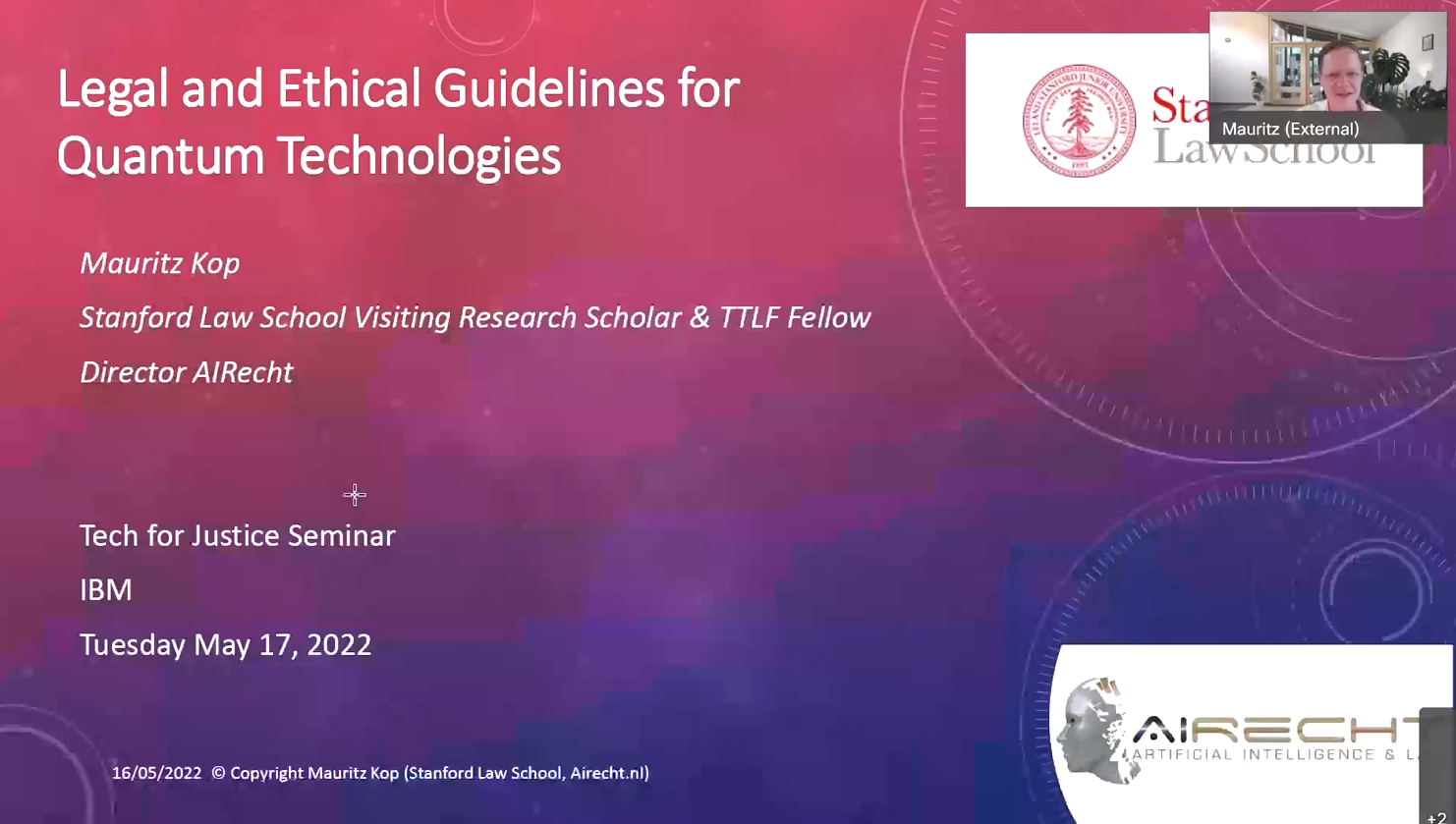
IBM Invites Mauritz Kop for Lecture on Quantum Ethics

New York, May 17, 2022—The development of quantum technology represents a significant advance in computational capability, with the potential to reshape industries, accelerate scientific discovery, and address complex problems. As with other transformative technologies, its power introduces a range of responsibilities. The relevant questions are not only about the technical capabilities of quantum mechanics, but also about the appropriate uses of the technology.

Reflecting this, IBM, a leading company in the quantum field, convened a seminar on May 17, 2022, for its New York and San Francisco teams to focus on the legal and ethical dimensions of this emerging field. The invited speaker for the event was Mauritz Kop, a visiting scholar at Stanford Law School, who presented his work on establishing a governance framework for quantum technologies to an audience of researchers, engineers, and policymakers.

The event was part of IBM's Tech for Justice initiative, a cross-divisional program dedicated to using technology to address systemic biases and advance social equity. Situating the conversation about quantum ethics within this framework indicates an understanding that principles of fairness, accountability, and transparency should be integrated into new technologies from an early stage.

The session was hosted by Dr. Aminat Adebiyi, a Research Staff Member, Experimentalist, and Maker at IBM, and moderated by Dr. Mira Wolf-Bauwens. Kop's collaboration with Wolf-Bauwens includes their shared work on the World Economic Forum's foundational principles for quantum computing, a project that highlights the role of multi-stakeholder cooperation in this area.

The Quantum Vanguard: IBM's Technological Position

To understand the context of the ethical discussion, it is useful to consider the technological landscape. IBM Quantum is one of the leading organizations in quantum computing and has achieved notable milestones in the field. Central to its strategy is the development of universal fault-tolerant quantum computers based on superconducting transmon qubits. This approach, which involves creating and manipulating quantum states in circuits cooled to cryogenic temperatures, has enabled IBM to build increasingly powerful and stable quantum processors.

Charting a Course for Responsible Quantum Development: A Summary of the Lecture

The material presented in the lecture builds upon a body of foundational research by Kop. His work in the Yale Journal of Law & Technology first proposed a comprehensive legal-ethical framework and a set of ten guiding principles for quantum technology. In the Stanford Law School Transatlantic Technology Law Forum, he explored the crucial roles of intellectual property and standardization in fostering sustainable innovation. Furthermore, in Physics World, published by the Institute of Physics, he articulated the necessity of a dedicated field of "quantum ethics," urging the physics community to engage directly with the social and moral implications of their work. Lastly, together with Luciano Floridi at Oxford, Kop conceptualized the Quantum-ELSPI framework as the ethical, legal, social, and policy implications of the suite of quantum technologies. The lecture for IBM synthesized and advanced these core themes.

Kop's lecture, "Legal and Ethical Guidelines for Quantum Technologies," was structured around the thesis that there is a timely opportunity to establish governance for quantum technology. In contrast to the development of the internet or artificial intelligence, where regulation often followed widespread adoption, it is possible to proactively embed democratic values and human rights principles into the architecture of quantum systems.

Interactive Discussion and Call to Action

The lecture was followed by an engaging Q&A session that highlighted the deep commitment of the IBM technical community to responsible innovation. The questions posed by participants explored the practical challenges and nuances of implementing ethical frameworks. Key themes of the discussion included the tangible impact of tech regulation to date, the specific processes needed to assess quantum's potential societal effects, and the distinct yet complementary roles of government and private enterprise in setting and adhering to standards.

Participants were keen to understand how a framework could effectively infuse 'humanism' into every aspect of technology development and how regulation could be used proactively to shape an emerging field for the better. The dialogue also addressed the most significant challenges facing quantum regulation specifically and the strategies required to overcome them.

Meer lezen
Montreal World Summit AI 2022 Features Mauritz Kop Keynote on EU AI Act

Montreal, Canada – May 4, 2022 – Today, at the prestigious World Summit AI Americas held at the Palais des congrès, Mauritz Kop, TTLF Fellow at Stanford Law School and Director of AIRecht, provided a concise overview of the proposed EU Artificial Intelligence Act. He was a featured panellist in a critical discussion titled, "Does the proposed EU Artificial Intelligence Act provide a regulatory framework for AI that should be adopted globally?". The summit, themed "AI with impact: for crisis response and business continuity and recovery," brings together leading AI brains and enterprise leaders.

Mr. Kop joined fellow distinguished panellists Professor Gillian Hadfield from the University of Toronto and Dr. José-Marie Griffiths, President of Dakota State University and former NSCAI Commissioner. The session was moderated by Meredith Broadbent, Former Chairman of the U.S. International Trade Commission and Senior Adviser at CSIS.

Novel Legal Framework for AI

During the panel, Mr. Kop outlined the main points of the novel legal framework for AI presented by the European Commission on April 21, 2021. He explained that the EU AI Act sets out horizontal rules applicable to all industries for the development, commodification, and use of AI-driven products, services, and systems within the EU's territory.

A core component of the Act is its sophisticated ‘product safety framework’, which is constructed around four distinct risk categories in a "pyramid of criticality". This risk-based approach dictates that AI applications with unacceptable risks are banned, while lighter legal regimes apply to low-risk applications. As the risk level increases, so do the stringency of the rules, ranging from non-binding self-regulation and impact assessments for lower-risk systems to potentially heavy, externally audited compliance requirements throughout the lifecycle of high-risk AI systems.

EU "Trustworthy AI" Paradigm

Mr. Kop emphasized that the Act aims to codify the high standards of the EU’s "trustworthy AI" paradigm, which mandates that AI systems must be legal, ethical, and technically robust, all while respecting democratic values, human rights, and the rule of law. A crucial aspect highlighted was the requirement for market entrance and certification of High-Risk AI Systems through a mandatory CE-marking procedure. This pre-market conformity regime also extends to the machine learning training, testing, and validation datasets used by these systems. Only after a declaration of conformity is signed and the CE marking is affixed can these high-risk systems enter and be traded on the European markets.

Enforcement will be managed by a new Union-level body, the European Artificial Intelligence Board (EAIB), supported by national supervisors in each Member State, similar to the GDPR's oversight structure. Mr. Kop noted the seriousness of non-compliance, with potential fines reaching up to 6% of a company's global turnover.

Balancing regulation with innovation, the EU AI Act also introduces legal sandboxes. These are designed to provide AI developers with "breathing room" to test new inventions and foster a flourishing AI ecosystem in Europe.

Meer lezen
Scarcity, Regulation, and the Abundance Society Roundtable at Stanford Law

In 2022, Mauritz Kop had the honor of contributing a chapter to the book project "Scarcity, Regulation, and the Abundance Society," a special volume of Frontiers in Research edited by two leading minds in technology law, Professor Mark Lemley of Stanford Law School and Professor Deven Desai of Georgia Institute of Technology. The project culminates years of research and dialogue, including a memorable and insightful roundtable held at Stanford Law School.

The central inquiry of the project is to explore how our legal and economic institutions, which are fundamentally built on scarcity, should respond as "technologies of abundance" make scarcity a thing of the past in many industries. As new technologies like AI, 3D printing, and synthetic biology democratize and disrupt production, the book examines whether we will try to legally replicate scarcity or reorder our society to focus on things other than scarcity.

The "Abundance and Equality" Chapter Edited by Mark Lemley

His chapter, titled "Abundance and Equality," was edited by Mark Lemley and connects the concepts of good governance and the end of scarcity by unifying equality with technology-driven abundance. The piece introduces the Equal Relative Abundance (ERA) principle—a post-Rawlsian framework for distributive justice designed for an age of abundance.

The ERA principle builds on John Rawls's "difference principle" but integrates desert-based critique, arguing that unequal rewards for contributions (due to hard work, talent, or entrepreneurial spirit) are justified only to the extent that they also improve the position of the least advantaged members of society. The chapter examines how ten key exponential technologies of the Fourth Industrial Revolution—including AI, quantum technology, and biotechnology—are the primary drivers of this shift from scarcity to abundance. It critically analyzes our existing scarcity-based institutions, particularly property and intellectual property law, and posits that we must begin experimenting with hybrid systems that mix the best of forward-thinking socialist and ethical post-capitalist paradigms, built on a foundation of participatory democracy.

Mauritz Kop Presents Book Chapter at 2022 Stanford Law’s Abundance Roundtable

On April 22, 2022, the project's contributors gathered for a roundtable workshop at Stanford Law School. The event provided a forum for a deeply interdisciplinary group of scholars to present their work and engage in a robust dialogue about the future of our society. The format consisted of short 8-10 minute presentations followed by 20 minutes of discussion, fostering a rich exchange of ideas.

A Convergence of Post-Scarcity Presentations and Discussions

During his session, Kop presented the core arguments from his "Abundance and Equality" chapter, outlining the tension between technology-driven abundance and the persistent reality of inequality for many across the globe. He introduced the ERA principle as a moral and political guide for distributing the benefits and burdens of our increasingly abundant future.

The roundtable featured a breadth of perspectives. Vivek Wadhwa discussed solving humanity's grand challenges, while Funmi Arewa explored the scarcity of opportunity within the digital economy. Zahr Said and Joshua Fairfield tackled the creation of artificial scarcity through intellectual property and the legal status of virtual property in the age of NFTs, respectively. Shane Greenstein of Harvard Business School offered insights on supply chains and the platformization of clothing personalization. This convergence of ideas underscored the complexity of the transition ahead and the need for holistic solutions.

Musical Interlude: A Spontaneous Translation of Ideas

The roundtable was a stimulating intellectual affair, filled with rigorous debate. During lunch break, celebrating the occasion, Mauritz Kop sat down at the piano in the Stanford Faculty Lounge and performed a brief impromptu musical interlude. It was a personal endeavour to translate the abstract and often-dense themes of our discussion—the post-scarcity economy, abundance, equality, and the human condition—into the universal language of music. It was an opportunity for him to share that moment with his colleagues, connecting the analytical with the artistic.

The "Scarcity, Regulation, and the Abundance Society" project is a vital and timely undertaking. The discussions at the Stanford roundtable and the resulting publications provide a critical foundation for reimagining our legal, economic, and social institutions for a new era. These forward-looking conversations are essential for ensuring that the future of technological abundance is one that fosters not new forms of inequality, but greater justice and human flourishing for all.

Meer lezen