
Innovation, Quantum-AI Technology & Law

Blog over Kunstmatige Intelligentie, Quantum, Deep Learning, Blockchain en Big Data Law

Blog over juridische, sociale, ethische en policy aspecten van Kunstmatige Intelligentie, Quantum Computing, Sensing & Communication, Augmented Reality en Robotica, Big Data Wetgeving en Machine Learning Regelgeving. Kennisartikelen inzake de EU AI Act, de Data Governance Act, cloud computing, algoritmes, privacy, virtual reality, blockchain, robotlaw, smart contracts, informatierecht, ICT contracten, online platforms, apps en tools. Europese regels, auteursrecht, chipsrecht, databankrechten en juridische diensten AI recht.

Berichten in Artificial Intelligence
Cursus AI, Data, Privacy en Innovatie in de Zorg

Suzan Slijpen, Sander Ruiter en Mauritz Kop over AI in de Zorg

Op 31 oktober 2019 gaven Suzan Slijpen, Sander Ruiter en Mauritz Kop een cursus AI, Data, Privacy en Innovatie in de Zorg in het Maasstad Ziekenhuis Rotterdam. Wij waren daar te gast op uitnodiging van Quint Wellington Redwood, een leading consultancy firm die organisaties ondersteunt bij het ontwerpen en operationaliseren van hun digitale strategie waarbij mensen, processen en technologie centraal staan.

Gebruik van patiëntgegevens, medische hulpmiddelen, datadelen, privacy & AI in het ziekenhuis

Doel van cursus was om helderheid te scheppen in de wettelijke regels over het gebruik van patiëntgegevens, datadelen, eigendom van trainingsdatasets, medical devices, privacy en artificiële intelligentie in het ziekenhuis. AIRecht werd ingeschakeld om expertise te geven over dit complexe en uitdagende onderwerp. Om barrières weg te nemen voor innovatie. Onder de aanwezigen waren het Maasstad Ziekenhuis Rotterdam management team, de CISO (Chief Information Security Officer), enkele artsen, radiologen en verpleegkundigen. Ook waren er data scientists uitgenodigd van Parnassia Groep, specialisten in geestelijke gezondheid.

Keynote Digitale Zorg - Medical Devices, Patiëntdata, MDR & AVG

Nieuwe Europese regelgeving (MDR) voor Medical Devices waaronder zorgrobots, medische producten, hulpmiddelen en medische software vanuit een AI-helicopterview, die in 2020 in Nederland van kracht wordt. Verhouding tussen de AVG en de MDR. Gebruik en uitwisseling van patiëntdata, informatiebeveiliging en digitale zorg: wat mag er wel en niet op basis van de Europese Privacywetgeving (AVG/GDPR)?

Meer lezen
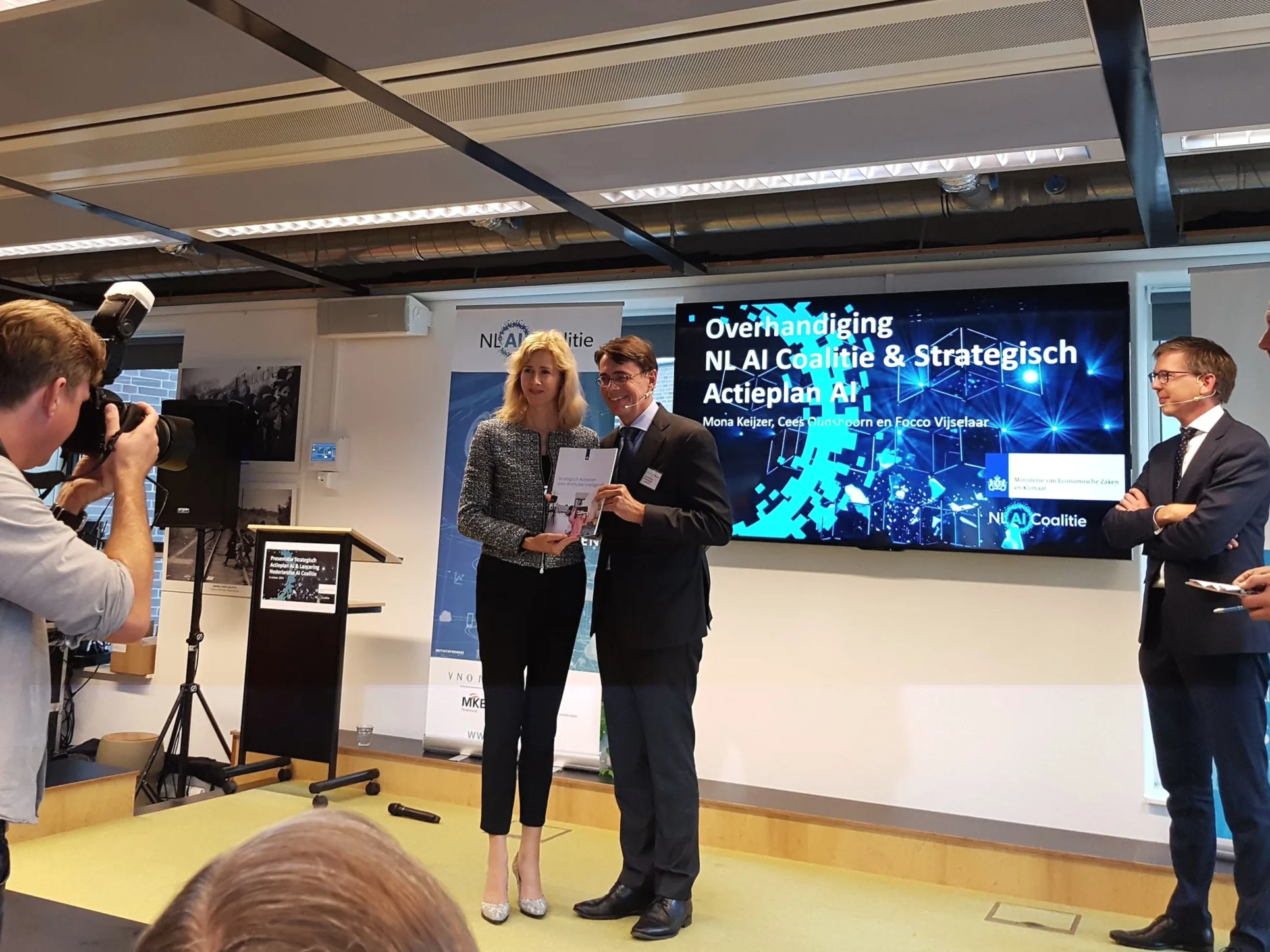
Dutch AI Coalition and Strategic Action Plan Artificial Intelligence

State Secretary Mona Keijzer launches Dutch AI Coalition and presents Strategic Action Plan AI for The Netherlands

65 Organizations, including our company AIRecht, are joining forces to ensure that the Netherlands becomes a major player in the field of artificial intelligence (AI).

Kick-off Dutch AI Coalition

More than 65 parties from the business community, government, education and research institutions and social organizations have joined the Dutch AI Coalition that launched on 8 October 2019. The Dutch AI Coalition (NL AIC / Nederlandse AI Coalitie) is a public-private partnership that functions as the catalyst for AI in The Netherlands. From leading multinationals IBM, Philips, Seedlink, Rabobank, KLM, Delft University and Amsterdam University, numerous SMEs to the police and knowledge institutions such as TNO and CLAIRE.

Strategic Action Plan AI of the Dutch Government (SAPAI)

It was a great day for AI-policy and technology driven innovation in The Netherlands. The Strategic Action Plan AI of the Dutch Government (SAPAI) follows a coordinated AI-policy approach on 3 tracks, including the implementation of knowledge and innovation agendas per industry sector (Health, AgriFood, Energy, Mobility), top research in the field of AI, the stimulation of AI entrepreneurship, the promotion of consumer rights and fair digital competition on online platforms, as well as safeguarding public values, human rights and fundamental freedoms through responsible and trustworthy tech, based on our shared European legal and ethical values.

Meer lezen
Suzan Slijpen Conference Speaker at the National University of Ireland

Legal Aspects of AI in Healthcare

On 16 August 2019, Suzan Slijpen LL.M. had the honour to speak about the legal aspects of the development and use of artificial intelligence (a disruptive technology) in healthcare, at the AI in Medicine Conference organized by the Irish Association of Physicists in Medicine (IAPM). The conference took place in Galway, at the National University of Ireland (School of Physics, NUI Galway/ OÉ Gaillimh). Suzan is a senior legal consultant at AIRecht.nl, and specializes in eHealth & medical devices, pharmaceutical law, European food law and contract law, from an AI helicopterview. She is also founder and lawyer at boutique law office Slijpen Legal.

Key topics of the Artificial Intelligence in Medicine lecture

Key legal topics that Suzan addressed in her Artificial Intelligence in Medicine lecture:

1. AI & Robotics: Disruptive Technologies: Synergetic effects of 4th Industrial Revolution technologies like robotics, big data, quantum computing, Blockchain, Virtual Reality (VR) and Internet of Things (IoT).

2. eHealth and medical devices: legal classification.

3. Fundamental Rights: Safeguarding of Fundamental Rights in AI applications, Rights of Patients.

4. Ethics and responsible AI: 1791 French Revolution Values, HLEG Concept of Trustworthy AI.

5. Intellectual Property on AI and Health Apps: Licensing your IP.

6. Liability for damages caused by smart robots: who is liable for misdiagnosis by an AI algorithm?

7. Legislation and Jurisprudence.

8. AI Impact Assessment: remove roadblocks for AI.

Legislation and regulations regarding AI in Healthcare

Do you want to know more about legislation and regulations regarding AI in Healthcare, or Legal aspects of disruptive tech in Medicine? Or do you want to organize a workshop or conference yourself and invite us as a speaker or teacher? Then please contact us about the possibilities!

Meer lezen
AI for Independent Law Firms: Mauritz Kop Speaks at The Law Firm Network Annual Conference in Amsterdam

Law firms and AI: Mauritz Kop addressed The Law Firm Network — the international association of independent law firms, founded in 1989 — at its 2021 Annual Conference in Amsterdam, hosted by Wieringa. The subject was the question every managing partner now owns: what does artificial intelligence change about legal work itself, and what must a firm regulate before it adopts the technology?

AI as production technology for legal work

Document review, drafting support and knowledge retrieval put artificial intelligence inside the law firm itself — and with it questions of confidentiality, supervision and liability for machine-assisted work product. Which client data may leave the building when a tool runs in someone else's cloud? Who stands behind a machine-drafted first version, and how is that review evidenced? And when the analysis misses the decisive clause, who carries the claim — vendor, firm or insurer?

The regulatory wave reaching clients

Risk classes, conformity obligations and governance: in the same period the European Commission tabled its April 2021 proposal for what has since become the adopted EU AI Act. Firms advising across borders need a shared vocabulary for the European approach to AI before their clients ask for it — and a risk-based, phased regulation rewards exactly the early gap analysis that independent firms can offer regional clients without global compliance departments.

Why managing partners are the right room

The audience is the leverage: managing partners set technology policy, sign vendor contracts and answer to clients in their own jurisdictions. Their questions are operational — what to pilot first, what to tell the professional-indemnity insurer, how to brief partners who did not grow up with the technology — and a legal frameworks session has to answer them concretely or it is scenery. The article sets out the four-step readiness sequence a mid-sized firm can actually run: inventory, contracts, supervision, client posture.

Networks spread readiness

One session, many jurisdictions: teaching an international assembly of independent firms multiplies through every member — each firm carries the frameworks home to its own bar context, client base and supervisory rules, turning one Amsterdam afternoon into dozens of localized conversations about confidentiality, supervision and AI governance. It is part of a broader teaching practice, from universities to professional associations, including the SandboxAQ lecture and workshop. The law of AI is converging across Europe; its adoption happens one firm, one engagement letter and one procurement decision at a time.

Meer lezen