
Harvard Law Publishes Hippocratic Quantum: The Ethics of Biomedical Discovery in the Quantum Age
Cambridge, MA, February 25, 2026—Harvard Law’s Petrie-Flom Center has published Mauritz Kop’s new article, Hippocratic Quantum: The Ethics of Biomedical Discovery in the Quantum Age: https://petrieflom.law.harvard.edu/2026/02/25/hippocratic-quantum-the-ethics-of-biomedical-discovery-in-the-quantum-age/
The article advances a proposition that is becoming increasingly difficult for health lawyers, policymakers, and biomedical innovators to ignore: as quantum technologies begin to enter biomedical discovery, the decisive challenge is no longer only scientific capability, but rather governance. In Kop’s account, quantum-enabled medicine should not be understood as a distant or speculative frontier that can be regulated later, once the engineering settles. It should instead be approached as a present-tense quantum governance problem, one that already implicates patient confidentiality, data integrity, cyber resilience, export controls, supply chains, and the geostrategic value of biomedical knowledge.
That shift in emphasis matters. Much discussion of quantum technology still oscillates between theoretical technical promise and abstract ethical concern. Hippocratic Quantum takes a more institutional view. It asks what it would mean to translate the familiar principles of biomedical ethics—autonomy, beneficence, non-maleficence, and justice—into practical standards of care for a domain in which computational power, sensing, simulation, and networking may change the scale, fidelity, and strategic significance of biomedical research. The article’s answer is not a new morality, but a more demanding implementation of an existing one: quantum medicine requires a Hippocratic framework that is technical enough for engineers, legal enough for regulators, and concrete enough for hospitals and pharmaceutical firms, yet flexible enough to let innovation breathe and encourage the crucial public-private investment necessary to advance allied quantum capabilities.
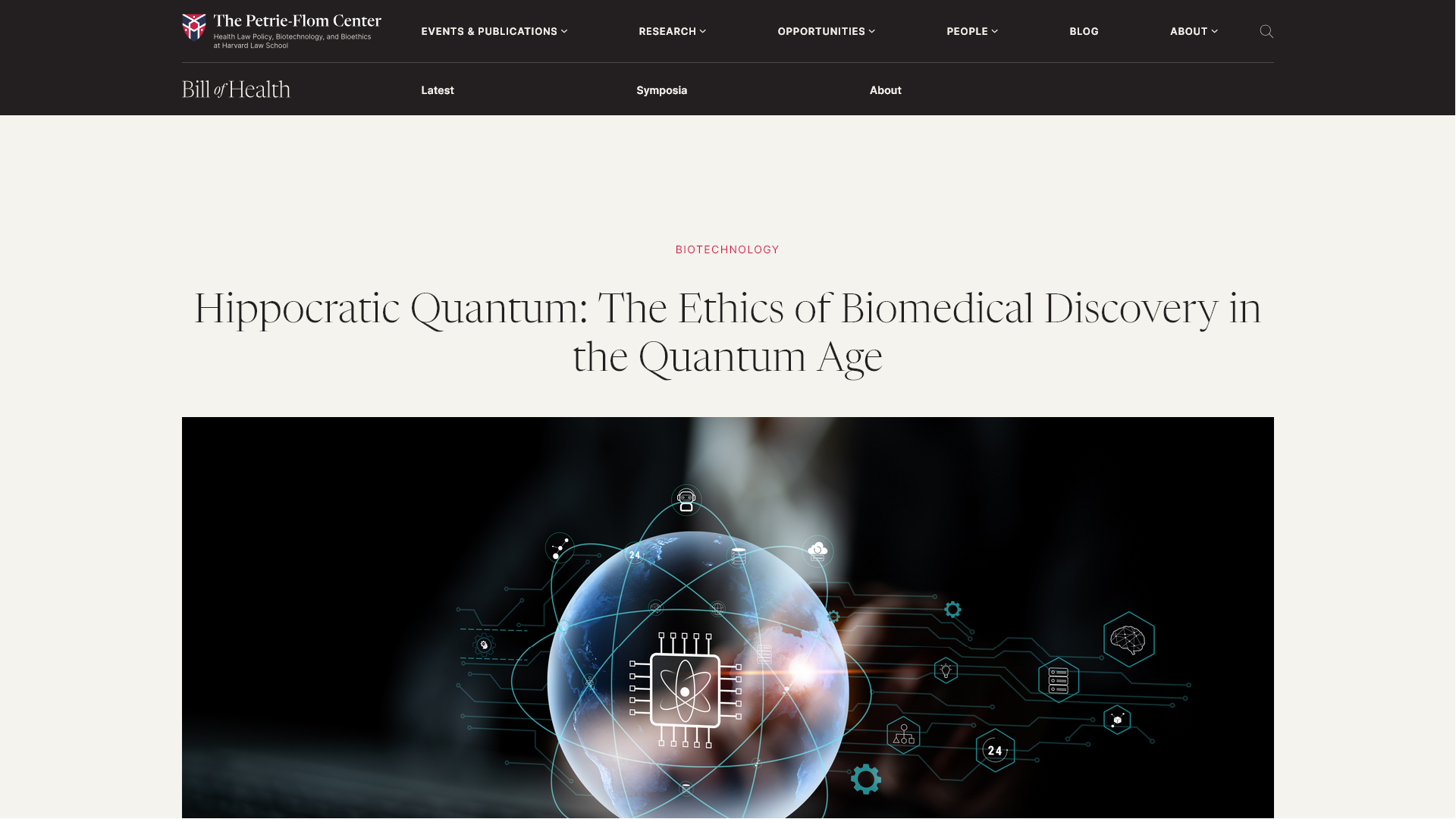
Harvard Law Publishes Hippocratic Quantum: The Ethics of Biomedical Discovery in the Quantum Age
Five examples of quantum-enabled biomedical innovations
To ground this institutional view, one must consider the specific technological capabilities currently transitioning from theoretical physics to applied biomedicine. Five feasible vectors of innovation illustrate the breadth of this shift. In the domain of quantum computing, hybrid classical-quantum algorithms are emerging to optimize complex drug discovery pipelines and process large-scale genomic datasets. In quantum sensing, technologies such as diamond nitrogen-vacancy magnetometry enable ultra-sensitive, room-temperature mapping of neurological and cardiac activity. For quantum simulation, researchers are utilizing qubit-based systems to model molecular interactions and drug-target binding affinities with high accuracy, aiming to reduce reliance on extensive physical wet-lab screening. Within quantum imaging, techniques leveraging entangled photons permit the high-resolution visualization of cellular structures at lower light intensities, thereby mitigating phototoxicity in living tissues, benefitting medical diagnosis. Finally, in quantum networking, the deployment of quantum key distribution protocols offers a mechanism to cryptographically secure the transmission of sensitive multi-omics data across distributed hospital and research architectures.
From legal-ethical framework to Quantum-ELSPI
The Harvard article is best read as part of a longer intellectual trajectory. An early expression of that project appeared in March 2021 in the Yale Journal of Law & Technology, in Establishing a Legal-Ethical Framework for Quantum Technology: https://yjolt.org/blog/establishing-legal-ethical-framework-quantum-technology
That Yale piece argued that quantum technologies were moving from hypothetical ideas to commercial realities, and that law and policy should not wait for full technical maturity before building governance tools. It proposed a culturally sensitive legal-ethical framework for applied quantum technologies, drawing on AI governance and nanotechnology’s ELSI tradition while recognizing the distinct physical characteristics of quantum systems. Crucially, it also insisted that ethical aspiration must be accompanied by practical mechanisms for monitoring, validation, and life-cycle risk management. In retrospect, many of the themes that now reappear in Hippocratic Quantum were already visible there: the concern for human-centered design, the call for risk-based governance, and the insistence that ethics without institutionalization would be inadequate.
A second early intervention appeared in Physics World in December 2021, in Why we need to consider the ethical implications of quantum technologies: https://physicsworld.com/a/why-we-need-to-consider-the-ethical-implications-of-quantum-technologies/
That article played a different but complementary role. Where the Yale piece established legal-ethical architecture, the Physics World article widened the aperture and addressed a broader scientific and public audience. It argued that quantum technologies were already mature enough to justify ethical scrutiny and that governance should develop in parallel with the technology rather than in its wake. It helped make the case that quantum ethics was not a niche curiosity, but a necessary response to a family of technologies likely to become economically and socially consequential.
In parallel, beginning in mid-2021, a more formal field-building effort emerged around Quantum-ELSPI—ethical, legal, social, and policy implications of quantum technology, an initiative closely associated with the research agenda of the Stanford Center for Responsible Quantum Technology (Stanford RQT). That trajectory is reflected in the Stanford Law publication page for Quantum-ELSPI: Ethical, Legal, Social, and Policy Implications of Quantum Technology: https://law.stanford.edu/publications/quantum-elspi-ethical-legal-social-and-policy-implications-of-quantum-technology/
The same research agenda was later formalized in Springer Nature’s Digital Society in Quantum-ELSPI: A Novel Field of Research: https://link.springer.com/article/10.1007/s44206-023-00050-6
That article did more than coin a label. It gave the field a coherent interdisciplinary structure, drawing together ethics, law, policy, and social analysis around quantum technology’s emerging applications. In parallel, Harvard’s Berkman Klein Center published Towards Responsible Quantum Technology, which articulated a broader responsible-innovation framework and proposed the SEA approach—safeguarding against risks, engaging stakeholders, and advancing quantum technology in a responsive and socially grounded manner: https://cyber.harvard.edu/publication/2023/towards-responsible-quantum-technology
Read together, these publications show a progression from early legal-ethical framing, to public-facing ethical argument, to field formation, to responsible quantum governance. Hippocratic Quantum is best understood as the biomedical instantiation of that progression.
More from Mauritz at Harvard.
Why quantum medicine changes the governance question
The new Harvard article narrows the focus to biomedicine, but in doing so it sharpens the stakes. Biomedical discovery is not simply another application area. It is a setting in which long-lived and highly sensitive data, bodily integrity, public-health interests, commercial incentives, and geopolitical competition intersect. Quantum technologies matter here not because they promise speculative disruption, but because they may incrementally and then materially improve specific tasks: hybrid quantum-classical computational chemistry, de novo molecular design, lead optimization, selected toxicity and metabolism modeling, and perhaps aspects of high-fidelity sensing, simulation, and networked quantum computation. The issue, then, is not whether every promise will be realized immediately. It is whether institutions are preparing now for the forms of capability that are already foreseeable.
In this context, the article’s framing around “the end of privacy and identity” is especially notable. The concern is not only that future quantum computers may threaten today’s public-key encryption. It is also that quantum-enabled computation, sensing, and networking, when combined with ubiquitous data, may erode practical obscurity and make personal inference more durable. In medicine, where health records, genomic data, imaging archives, and diagnostic profiles may remain sensitive for decades, that prospect has direct ethical and regulatory implications. The article therefore asks institutions to think of privacy and identity not as static compliance categories, but as dynamic governance problems that must be built into technical architecture, procurement, and standards of care.
Where the article becomes operational
The practical center of gravity of Hippocratic Quantum lies in its discussion of near-term duties for healthcare and pharma. This is where the article moves decisively from ethical vocabulary to institutional action.
The first duty is post-quantum cryptography. If malicious actors can steal encrypted health and genomic data now and decrypt it later once quantum capabilities mature, then confidentiality can no longer be treated as a timeless guarantee. It becomes a horizon problem. For that reason, the article argues that post-quantum cryptography should begin to function as an emerging standard of care for long-lived biomedical data. That has immediate consequences for hospitals, research institutions, and firms: inventory cryptographic dependencies, prioritize high-value and long-duration repositories, demand vendor roadmaps, and migrate toward crypto-agile systems that can be updated as standards evolve. This is not futuristic speculation. It is ordinary governance meeting an unusual time-lag problem.
The second duty concerns the integrity and provenance of the patient file. Here the article makes a subtle but important move. The end of privacy is not framed solely as broken encryption. Quantum-secure infrastructures can also increase traceability and identity binding. In favorable settings, tools such as quantum physical unclonable functions may help authenticate pharmaceuticals and reduce counterfeiting, while quantum position verification could improve anti-fraud controls or location-bound access. Yet the same technical affordances may also intensify exclusion, create persistent identity markers, and narrow the possibility of contesting or escaping a technical identity assignment. The article’s point is that these are not merely engineering trade-offs. They are clinical and human-rights questions. Governance must therefore require tamper-evident records, auditability, strict access controls, and safeguards designed for contestability, revocation, and bounded use.
The third duty is evidence-led discovery governance. Here Kop resists both overstatement and complacency. The article does not claim that quantum simulation will soon replace classical modeling or animal testing wholesale. It argues, more modestly and more credibly, that quantum-assisted methods may reduce wet-lab cycles and improve screening in certain domains, provided they are validated against classical baselines and empirical evidence. The proposed instrument is the Quantum Impact Assessment: an ex ante framework for documenting validation criteria, model limits, security planning, dual-use risks, and safety assumptions before clinical translation. In effect, the article treats ethics as something that must be recorded, audited, and institutionally enforced rather than merely declared.
The Quantum Nexus, the LSI test, and the democratic industrial commons
Another notable contribution of the article is that it refuses to isolate bioethics from geopolitics. It argues that quantum-enabled biomedical discovery is a dual-use domain. The same simulation tools that may advance therapeutics may also lower barriers to harmful replication, including the design of pathogens or toxins. That insight links the article to a broader body of work on the nexus of quantum technology, intellectual property, and national security, including The Nexus of Quantum Technology, Intellectual Property, and National Security: An LSI Test for Securing the Quantum Industrial Commons: https://arxiv.org/abs/2602.15051
The LSI test—least-trade-restrictive, security-sufficient, innovation-preserving—offers a disciplined way to think about disclosure, control, and openness. Rather than collapsing into either unrestricted openness or maximal restriction, it proposes tiered disclosure: publish or patent validated performance claims where appropriate, while restricting access to technical details and tacit know-how that would materially elevate misuse risk. In the biomedical setting, that logic becomes especially salient because the boundary between therapeutically useful knowledge and dangerous knowledge may be narrow, context-dependent, and geopolitically consequential. The article therefore situates biomedical ethics within a wider democratic governance project: how to preserve innovation while protecting the democratic industrial commons from avoidable vulnerability. Ultimately, this approach relies on a necessary synthesis of ethics + geopolitics to protect the democratic quantum biomedical commons.
A Harvard-facing research arc
This Harvard publication also extends a longer Harvard-facing research arc across AI, health law, and responsible quantum governance. That arc includes:
The Right To Process Data For Machine Learning Purposes In The EU (Harvard JOLT) https://jolt.law.harvard.edu/digest/the-right-to-process-data-for-machine-learning-purposes-in-the-eu
Towards Responsible Quantum Technology (Harvard Berkman Klein) https://cyber.harvard.edu/publication/2023/towards-responsible-quantum-technology
EU And US Regulatory Challenges Facing AI Health Care Innovator Firms (Harvard Petrie-Flom) https://petrieflom.law.harvard.edu/2024/04/04/eu-and-us-regulatory-challenges-facing-ai-health-care-innovator-firms/
A Brief Quantum Medicine Policy Guide (Harvard Petrie-Flom) https://petrieflom.law.harvard.edu/2024/12/06/a-brief-quantum-medicine-policy-guide/
How Quantum Technologies May Be Integrated Into Healthcare: What Regulators Should Consider (Stanford Law) https://hls.harvard.edu/bibliography/how-quantum-technologies-may-be-integrated-into-healthcare-what-regulators-should-consider/
Seen in this broader context, Hippocratic Quantum brings together early legal-ethical framing, responsible quantum governance, healthcare regulation, and geopolitical analysis into a single biomedical governance argument.
For policymakers, that is the article’s clearest message. Quantum medicine will not be governed well by ethics alone, nor by technical standards alone, nor by security policy alone. It will require all three to be woven together. The task is not merely to celebrate discovery, but to decide what forms of discovery should be secured, disclosed, validated, and institutionalized—and on what terms.