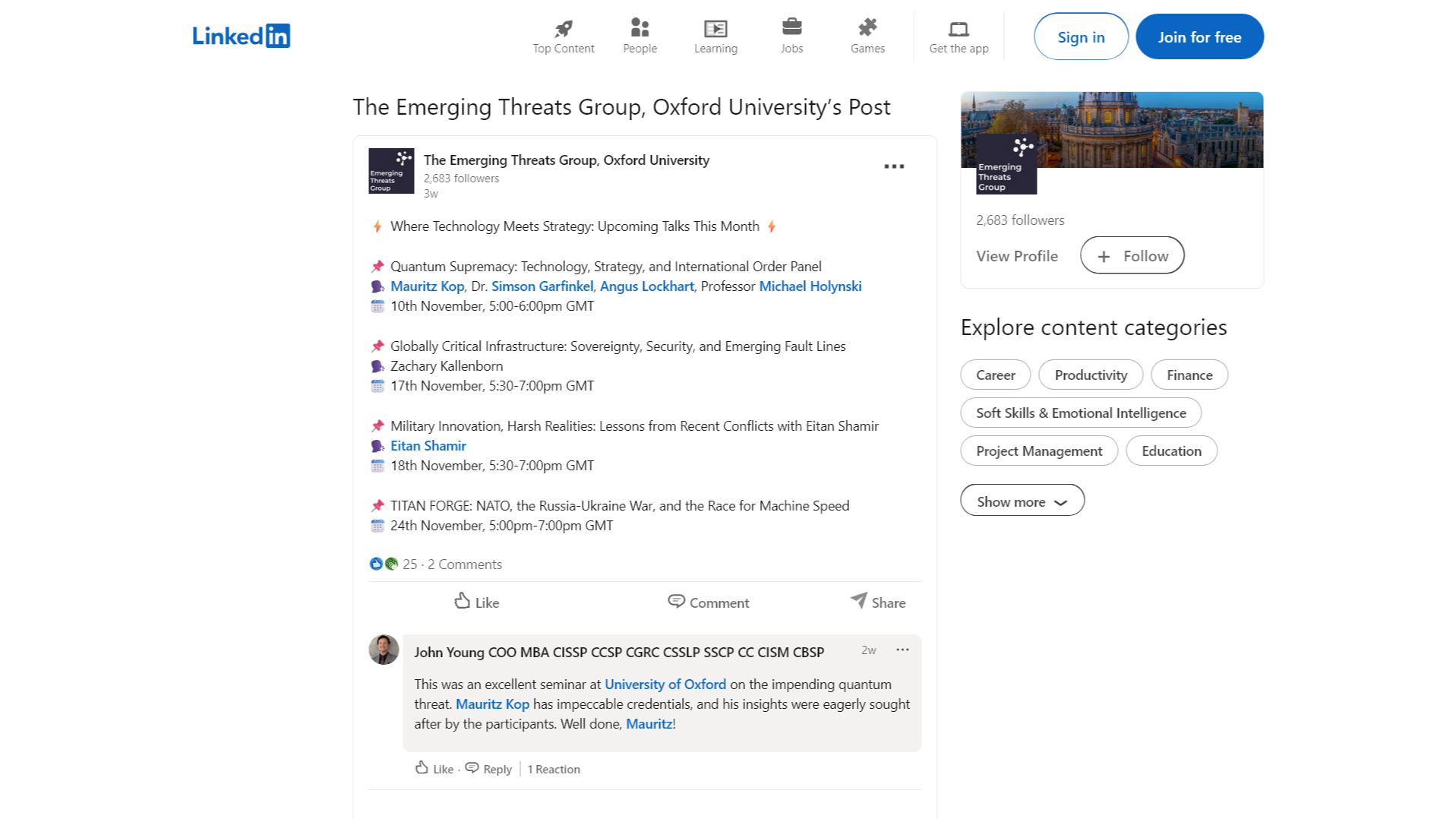
Mauritz Kop Speaks at Oxford University on Quantum Threats
Oxford University, 10 November 2025—This afternoon, Professor Mauritz Kop joined distinguished colleagues at the University of Oxford for a high-level panel discussion titled “Quantum Supremacy: Technology, Strategy, and International Order.” Hosted by the Department of Politics and International Relations (DPIR) and the Oxford Emerging Threats & Technology Working Group (ETG), the event convened a diverse audience of scholars, policymakers, and industry leaders to dissect the rapidly evolving landscape of quantum technologies.
Moderated by Sarah Chen, the session moved beyond the hyperbolic headlines often associated with quantum computing to address the granular realities of strategy, governance, and international security. Alongside Kop, the panel featured Dr. Simson Garfinkel of BasisTech, Angus Lockhart of SECQAI, and Professor Michael Holynski of the UK Quantum Technology Research Hub. The resulting dialogue offered a dense, forward-looking examination of quantum threats and opportunities—ranging from the precision of quantum sensing and the urgency of post-quantum cryptography (PQC) to the geopolitical friction points of supply-chain resilience and the risk of sub-optimal governance lock-in.
Mauritz Kop joins the Quantum Supremacy: Technology, Strategy, and International Order Panel, hosted by the Department of Politics and International Relations (DPIR) and the Oxford Emerging Threats & Technology Working Group (ETG).
The Mission of Oxford’s Emerging Threats & Technology Working Group
The context for this discussion was set by the unique mandate of the host organization. The Emerging Threats & Technology Working Group at Oxford University stands as one of the few academic platforms systematically examining how critical and emerging technologies (CETs) reshape the security environment. Meeting regularly to assess the national-security implications of technologies such as artificial intelligence, quantum computing, directed energy, and space systems, the ETG brings together participants from academia, industry, and government in a hybrid format.
This institutional design is consequential. By convening interdisciplinary seminars and publishing detailed session reports, Oxford Emerging Threats builds a community capable of treating quantum technology not merely as a laboratory curiosity or a narrow industrial race, but as a systems problem. Within this forum, quantum is framed as a variable that touches deterrence, alliance cohesion, human rights, and the resilience of critical infrastructures. For Stanford RQT (Responsible Quantum Technology), represented by Kop, this mandate aligns closely with the necessity to develop governance, standards, and strategic frameworks that keep quantum innovation compatible with an open, rules-based international order.
Reframing the Narrative: From Quantum Supremacy to Allied Quantum Assurance
In his opening remarks, Kop challenged the utility of the term “quantum supremacy” when applied to state actors. While the term has technical validity in describing a computational threshold, legally and strategically it acts as a misleading metaphor. Kop argued that for democratic states, the more relevant concept is assurance: the ability of allies to deploy quantum-era capabilities in a way that is verifiable, interoperable, and resilient, while simultaneously preserving an open international order.
To operationalize this, Kop proposed the framework of Allied Quantum Assurance, a strategy built upon recognizing that the world is currently crossing a “quantum event horizon.” Much like an astrophysical event horizon represents a point of no return, the current governance tipping point implies that early decisions on standards, export controls, supply chains, and research security will lock allies into long-lasting path dependencies.
The immediate driver of this urgency is the “harvest-now, decrypt-later” (HNDL) risk—a metaphorical “Q-Day” scenario where data exfiltrated today is decrypted by a future, Shor-capable quantum computer. This reality reframes strategic stability: whereas classical nuclear deterrence rests on mutually assured destruction, quantum security centers on deterrence-by-denial, achieved through informational assurance and operational resilience.

Professor Mauritz Kop of Stanford RQT speaks at Oxford University on Quantum Threats, together with Dr. Simson Garfinkel of BasisTech, Angus Lockhart of SECQAI, and Professor Michael Holynski of the UK Quantum Technology Research Hub. Moderated by Sarah Chen.
The Two Frontiers of Quantum Competition
Kop’s contribution to the panel centered on the idea that allied outcomes will be decided on two distinct but interconnected fronts: the digital and the physical.
The Digital Front concerns the software and standards layer, specifically the migration to Post-Quantum Cryptography (PQC). Kop advocated for a “one test, many markets” regulatory approach. This entails verifiable delivery at home coupled with interoperable certification abroad—a strategy he termed the “Bletchley Park method.” By establishing PQC-by-default standards, interoperable certification schemes, and shared testing infrastructures, allies can link efforts such as NIST’s PQC standards (FIPS 203/204/205) with European cybersecurity certification frameworks.
The Physical Front concerns the tangible inputs of the quantum stack. Digital assurance fails without physical resilience. The quantum ecosystem rests on narrow supply chain nodes involving helium-3, cryogenics, niobium, photonics, and advanced magnets. Kop highlighted how these inputs are subject to the critical-minerals governance emerging through the EU’s Critical Raw Materials Act, U.S. critical-minerals policy, and the Minerals Security Partnership. Without careful management, these narrow nodes risk becoming chokepoints or levers of “weaponized interdependence.”
The Concept of Security-Sufficient Openness
A central theme of the discussion was the dilemma of maintaining innovation while ensuring security. Kop argued for a balance termed "Security-Sufficient Openness." This principle seeks to avoid two extremes:
1. Under-securitization: Allowing capability hemorrhages and illicit technology transfer through lax controls.
2. Over-securitization: Regulating so aggressively that it triggers a “Silicon Curtain,” fragmenting the global quantum ecosystem into a "splinternet" and driving open science into opaque, classified channels.
The practical challenge lies in designing export controls, investment screening, and dual-use governance—such as a future EU Quantum Act—that align promotion and protection rather than treating them as opposing goals.
During the discussion, the panel linked these concepts to concrete programs. Kop suggested that the Pentagon’s Replicator initiative—aimed at fielding autonomous systems at scale—should be made “quantum-ready.” This would entail PQC-hardened communications, robust positioning and timing, and modular quantum-sensor payloads. Furthermore, he pointed to AUKUS Pillar II as a venue not just for co-development, but for "war-gaming" supply chain vulnerabilities, ensuring that joint trials of quantum timing for GPS-independent navigation are supported by assured inputs.
Panel Contributions: Quantum Sensing, Cryptography, and Transition Risks
The session was distinguished by the depth of technical and strategic expertise provided by the other panelists, creating a holistic view of the threat landscape.
Quantum Sensing as a Near-Term Capability
Professor Michael Holynski (UK Quantum Technology Research Hub) emphasized that while quantum computing often dominates the headlines, quantum sensing is moving fastest from the lab to the field. The panel discussed how wearable quantum magnetometers are beginning to capture brain activity in clinical populations previously beyond the reach of conventional scanners. Furthermore, gravity-based sensors are enabling the detection of underground structures—such as tunnels—transforming both civil engineering and military operations. Perhaps most critical for national security is precision timing via quantum clocks, which is essential for robust Positioning, Navigation, and Timing (PNT) in GPS-contested environments. These examples illustrated that quantum is not solely about future code-breaking; it is already reshaping intelligence collection and critical infrastructure monitoring.
PQC as a Whole-of-Economy Transition
Dr. Simson Garfinkel (BasisTech, Harvard) and Angus Lockhart (SECQAI) brought combined cybersecurity and industrial perspectives to the PQC migration challenge. There was broad consensus that PQC represents one of the most consequential near-term transitions for governments and firms—a "Y2K-scale" challenge not because of a single failure date, but due to the sheer scope of institutional coordination required. The discussion highlighted that PQC is a modernization project requiring comprehensive inventories of cryptographic assets (including legacy systems embedded in infrastructure), new certification paths, and coordination across allies so that products certified in one jurisdiction are trusted in others.
Governance Dilemmas and the Risk of Falling Behind
The panel also examined the consequences for states that fail to keep pace. The risks are threefold:
1. Cryptographic Exposure: Delayed PQC migration invites HNDL operations, undermining alliance cohesion.
2. Industrial Lock-out: Latecomer countries risk becoming mere consumers rather than producers of quantum technologies, losing influence over emerging technical norms.
3. Governance Lock-out: Leading nations set the de facto standards and ethical norms. Falling behind means losing the ability to shape the "rules of the road" for the next technological epoch.

Mauritz Kop discusses PQC-Migration and the Qubits for Peace initiative at the Oxford Emerging Threats Group.
External Review and Synthesis
The impact of the session was further captured in a detailed review by Liberty Branston of Hertford College, Oxford. Branston’s report offers an excellent synthesis of the evening, highlighting how the discussion successfully bridged the gap between technical physics and international relations theory.
Her review notes the panel’s agreement that quantum sensing is already altering how states perceive bodies, cities, and battlefields, and that PQC migration serves as a litmus test for state capacity. Significantly, Branston’s account validates Oxford Emerging Threats’s broader effort to situate quantum technology alongside themes like globally critical infrastructure and algorithmic warfare. She observes that the panel moved beyond treating the topic as a technical curiosity, instead framing it as a driver of change in deterrence theory and the balance of power.
Conclusion: Qubits for Peace
The Oxford panel underscored that quantum technologies are rapidly transitioning from speculative research to strategic assets. Sensing is entering real-world deployments, PQC migration has begun in earnest, and the geopolitical contest over supply chains is intensifying.
For Stanford RQT, the insights shared at Oxford reinforce the necessity of advancing "security-sufficient openness" as a guiding principle. The ultimate goal, as Kop alluded to in his closing thoughts, is to embed the concept of "Qubits for Peace." By aligning the digital and physical fronts of allied assurance, nations can navigate the quantum event horizon without fracturing the global order. In this framework, quantum development becomes a primary driver of allied cohesion and trust—converting the friction of "supremacy" into the stability of "assurance."
Gratitude to Sarah Chen for her skillful moderation and organization of the event, and to Zachary Turinsky and the colleagues at Oxford’s DPIR and Emerging Threats Group for hosting this vital dialogue.
Sources:
Oxford Talks: Quantum Supremacy Panel (https://talks.ox.ac.uk/talks/id/8c717aea-150f-4ed0-bd94-c137d37f3ded/)
Emerging Threats Group at Oxford Event Page (https://emergingthreats.co.uk/event/week-5-quantum-supremacy-technology-strategy-and-international-order-panel/)
Review by Liberty Branston (https://emergingthreats.co.uk/review-quantum-supremacy-technology-strategy-and-international-order-panel/)