
Mauritz Kop Speaker at United Nations International Year of Quantum Science and Technology 2025
On 31 October 2025, Mauritz Kop, Founder of Stanford RQT (Responsible Quantum Technology), served as one of the main speakers at the North America regional workshop on the Ethical, Legal, and Social Aspects (ELSA) of Broadening Global Ownership of Quantum Technologies. The online workshop was part of the United Nations International Year of Quantum Science and Technology 2025 (IYQ 2025), a year-long initiative mandated by the United Nations General Assembly (UNGA) and led by the United Nations Educational, Scientific and Cultural Organization (UNESCO) to mark 100 years of quantum mechanics and to address the emerging “quantum divide” in access, skills, and infrastructure.
The North America edition was convened by Dr. Zeki C. Seskir and Professor Shohini Ghose as part of a six-region ELSA-of-quantum workshop series. Each regional workshop is feeding into a global IYQ event on the Ethical, Legal, and Social Aspects of Broadening Global Ownership of Quantum Technologies to be held in Istanbul in November 2025.
The program brought together four principal speakers—Mauritz Kop, Bruna Shinohara de Mendonça, Lindsay Rand, and Isabelle Lacroix—and designated commentators Rodrigo Araiza Bravo and Karl Thibault. The workshop closed with an open discussion in which participants reflected on regional needs, expected impact, and the kind of alignment that is necessary for a fair and secure quantum future.
North America regional workshop on the Ethical, Legal, and Social Aspects (ELSA) of Broadening Global Ownership of Quantum Technologies.
The International Year of Quantum and the North America ELSA Workshop
The International Year of Quantum Science and Technology 2025 was proclaimed by the United Nations General Assembly in June 2024. The resolution calls on states and international organizations to use 2025 to raise public awareness of quantum science, promote education and capacity-building—especially in the Global South—and strengthen cooperation so that all countries can participate in and benefit from quantum technologies.
Within this broader mandate, the ELSA of Broadening Global Ownership of Quantum Technologies initiative focuses on quantum governance. The North America workshop was explicitly framed around three questions:
Which ethical, legal, and social aspects of quantum technologies are most urgent for North America today?
Which ELSA topics are most important globally?
How should the future of ELSA and related policy implications be shaped in Europe, North America, and worldwide, and what forms of alignment are needed?
The three-hour program opened with an overview of the IYQ ELSA event series, followed by the four invited talks, a short break, and then a structured discussion and closing reflections.
Sponsors of the Global UN IYQ Fund.
From ELSA to ELSPI: A Metaparadigm for Quantum Governance
Kop’s keynote, “From ELSA to ELSPI: A Metaparadigm for Quantum Governance,” drew on his recent work on Quantum-ELSPI and Responsible Quantum Technology, including Quantum-ELSPI: A Novel Field of Research; Ten Principles for Responsible Quantum Innovation (co-authored with, among others, Raymond Laflamme); and his legislative blueprint Towards a European Quantum Act.
He began by defining Quantum-ELSPI (co-developed with Luciano Floridi then at Oxford, now at Yale) as the study of Ethical, Legal, Socio-economic, and Policy Implications of quantum technologies. Classical ELSA—Ethical, Legal, and Social Aspects—was designed for more conventional technologies and, in his view, is too narrow for quantum systems that combine:
Dual-use components that can be deployed for both civilian and military purposes;
Long security horizons, where sensitive data captured today may be decrypted decades later by cryptanalytically relevant quantum computers; and
Fragile supply chains, in which a handful of materials, cryogenic systems, or photonic components create systemic bottlenecks.
To address this, Kop articulated three foundational pillars of the Quantum-ELSPI metaparadigm, developed in a recent Science article with co-authors Mateo Aboy, Urs Gasser, Glenn Cohen, and others:
Standards-First Governance
Technical and assurance standards—such as post-quantum cryptography (PQC) profiles, quantum quality-management systems, and certification schemes—are treated as the primary vehicle for embedding values into systems. Law, policy, and institutional design are built around these standards rather than attempting to regulate hypothetical risks in the abstract.Execution-Oriented Ethics
Ethics is framed as a delivery problem. Instead of high-level value statements, Kop emphasized auditable supply chains, post-quantum cryptography migration drills, and verifiable deployment metrics in sectors such as finance, health care, and government archives. Ethics, in this sense, is measured by what actually ships and how it behaves under stress.Planetary Welfare
The third pillar reframes quantum technologies not only as instruments of national competitiveness or military advantage, but as ecological and health technologies. Quantum-ELSPI is thus aligned with the Sustainable Development Goals (SDGs), emphasizing applications in climate modeling, clean-energy materials discovery, quantum-enabled medical technologies, and resilient humanitarian communications.
Taken together, these pillars elevate Quantum-ELSPI from a narrow ethics add-on to a metaparadigm for governing the entire quantum stack—from materials and cryogenic infrastructure to cloud-based access, algorithms, and hybrid quantum–classical systems.
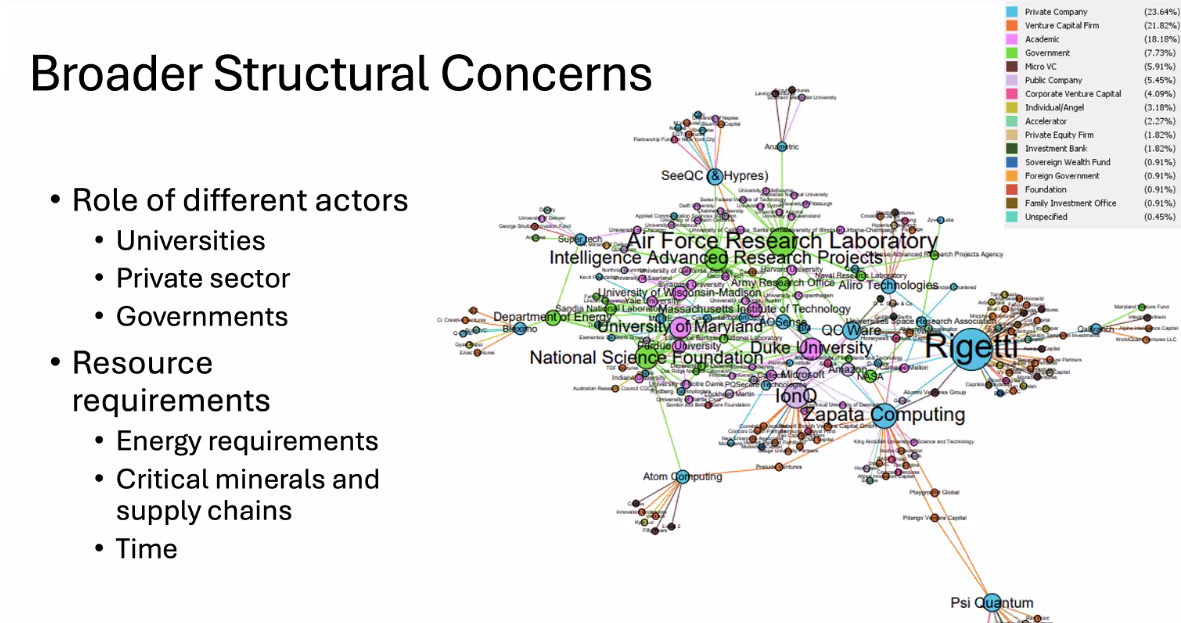
Using a network diagram of United States quantum-information-science funding and partnerships, Lindsay Rand showed how universities, private firms, and government agencies form dense hubs and “choke points” in the global quantum ecosystem.
Regional Lenses: Europe, North America, and the Planetary Layer
Kop then examined how the Quantum-ELSPI framework plays out across three levels: Europe, North America, and the planetary layer.
Europe: Values, Security, and Supply Chains
For Europe, the central focus is the narrow legislative window surrounding the proposed European Quantum Act, expected in 2026. Kop argued that this statute should be designed as a two-pillar framework, combining:
A risk-tiered regulatory pillar, analogous to the EU Artificial Intelligence Act; and
An industrial and security pillar, comparable to the EU Chips Act, targeting manufacturing, research infrastructure, and strategic autonomy.
He emphasized the importance of supply-chain criticality. Work at Stanford RQT (Responsible Quantum Technology) on a Quantum Criticality Index (QCI) has highlighted vulnerabilities around specific materials (for example, molybdenum) and enabling technologies such as cryogenics and single-photon detection. These findings feed directly into Kop’s recommendation that Ethical, Legal, Socio-economic, and Policy Implications be “baked into” the European Quantum Act, rather than treated as a separate, softer add-on.
United States and Canada: Security-Driven Quantum-ELSPI
Turning to North America, Kop framed the challenge as security-driven Quantum-ELSPI. The immediate priority is post-quantum cryptography migration, following the standardization of key algorithms such as Kyber and related schemes by the National Institute of Standards and Technology (NIST) in Federal Information Processing Standards (FIPS) 203, 204, and 205. Agencies are now building cryptographic inventories and planning the replacement of vulnerable public-key systems.
Kop underlined that so-called “harvest-now, decrypt-later” strategies—where adversaries store encrypted traffic today in anticipation of future quantum decryption—transform PQC migration into a human-rights and governance program, not merely a technical upgrade. Long-lived assets in finance, health, and government archives are particularly exposed.
He then linked this to tightening export-control and outbound-investment regimes in the United States. New rules require notifications or restrictions for certain quantum-related transactions. From a Quantum-ELSPI perspective, he argued, these instruments must be designed with shared risk language, allied license exceptions, and protection of the global prior-art pool for innovation. Here he drew on the Ten Principles for Responsible Quantum Innovation—including commitments to open standards and fair, reasonable, and non-discriminatory (FRAND) licensing—as tools for reconciling security concerns with open science and competition law.
The Planetary Level: A “Global Quantum Bargain”
At the planetary layer, Kop proposed a “Global Quantum Bargain.” He observed that recent frameworks from UNESCO, the Organisation for Economic Co-operation and Development (OECD), and the United Nations Global Digital Compact converge on a shared normative agenda: human-rights-compatible design, anticipatory governance, and diversified supply chains with inclusive skills development.
Quantum-ELSPI, in this reading, becomes a language for aligning:
Normative commitments (through the United Nations and OECD processes);
Regulatory architectures (for example, interoperable export controls and cybersecurity certification); and
Operational practices, modeled on a “Bletchley Park-style” method of shared drills, testbeds, and red-team exercises.
Kop closed his talk by arguing that Quantum-ELSPI is the bridge that allows Europe’s forthcoming Quantum Act and North America’s security-driven PQC and export-control regimes to meet in a single standards-first, human-rights-aware, and SDG-aligned operating model.
Empirical Perspectives: Bruna Shinohara de Mendonça on Exploring Responsible Quantum Innovation in Canada and the World
The second talk after Kop’s opening keynote was delivered by Bruna Shinohara de Mendonça, who is now working in industry and, at the time of the study, was affiliated with CMC Microsystems. Her presentation, “Exploring Responsible Quantum Innovation Efforts in Canada and the World,” reported on a multi-author project with Ria Chakraborty, Katya Driscoll, Rodolfo Soldati, and Ray Laflamme. The study assesses global quantum-technology efforts through a responsible-innovation lens derived from Kop’s “Ten Principles for Responsible Quantum Innovation” (Quantum Science and Technology, 2024), and asks where Canada is leading and where it risks lagging, in terms of development and regulation.
Shinohara de Mendonça offered a broader cartography of responsible quantum innovation (RQI) initiatives. A central feature of the talk was a slide explicitly reproducing the table from “Ten Principles for Responsible Quantum Innovation”, lead-authored by Mauritz Kop, former Stanford RQT (Responsible Quantum Technology) fellow and co-author Ray Laflamme, and colleagues. She used the three categories from that work—safeguarding, engaging, and advancing—and their associated principles to code and compare national and institutional efforts. In that sense, the Ten Principles functioned as the study’s normative backbone.
Shinohara de Mendonça then turned to the Canadian landscape. Drawing on the project’s forthcoming article (to appear on arXiv and in a special issue of Physics in Canada), she highlighted a set of RQI hubs and initiatives, including the Canadian Centre for Responsible Quantum Innovation and Technology (CRQIT) in Vancouver (inaugurated in June 2024), Institut quantique at the Université de Sherbrooke, the design-oriented network Open Quantum Design, and the Centre for International Governance Innovation (CIGI) (where Mauritz Kop is currently a Senior Fellow). Together, these efforts illustrate how Canada is attempting to institutionalize responsible-innovation practices within its quantum ecosystem, from basic research to commercialization and governance.
In her discussion of preliminary findings, Shinohara de Mendonça emphasized two main patterns. First, Canada performs comparatively well on ecosystem building and dialogue, with strong links between universities, policy think tanks, and start-ups. Second, gaps remain around formal regulatory frameworks and international coordination, particularly in relation to dual-use risks, intellectual-property governance, and equitable participation in global standard-setting. These are precisely the pressure points identified in the Ten Principles and in Kop’s broader Quantum-ELSPI work. By explicitly building on a framework co-developed at Stanford RQT (Responsible Quantum Technology) and with Laflamme, her talk provided an empirical complement to the more conceptual arguments in the opening keynote, showing how high-level principles can be used to benchmark real national strategies.
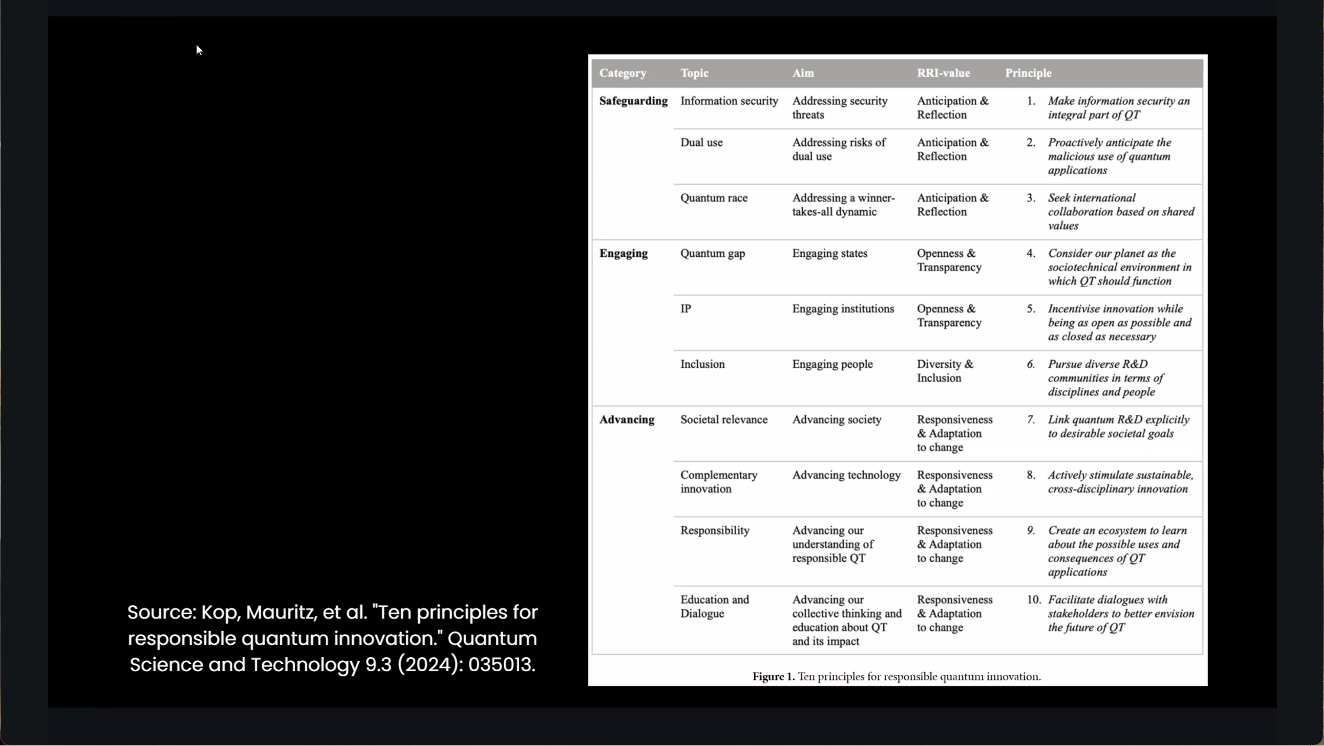
Kop et al.’s “Ten Principles for Responsible Quantum Innovation” (Quantum Science and Technology, 2024), served as the normative backbone for the Laflamme senior authored Exploring Responsible Quantum Innovation Efforts in Canada and the World empirical study.
Security, Deterrence and Public Engagement: Contributions from Lindsay Rand and Isabelle Lacroix
The security and public-engagement dimensions of Quantum-ELSPI were developed further by Lindsay Rand and Isabelle Lacroix, both of whom have longstanding connections to the responsible-quantum community. Rand, now based at the University of California, Berkeley, previously spoke at the Stanford RQT 2.0 (Responsible Quantum Technology) Conference in 2024 on quantum sensing and nuclear deterrence. Lacroix leads work at the Université de Sherbrooke’s Institut quantique, where she and her team run extensive dialogues with local and national stakeholders in Sherbrooke’s DistriQ Quantum Innovation Zone.
Rand’s presentation revisited and extended her earlier work on “Quantum Hype and Nuclear Deterrence.” One slide, titled “Government,” set out how states remain central actors for regulating information and technology—through classification decisions, approvals for specific technologies, security requirements, export controls, and funding—and how these same levers can decisively steer the direction of quantum research and commercialization. Another slide, “Quantum Hype and Nuclear Deterrence,” captured a core concern: even if some technical claims about quantum capabilities remain speculative, the belief that quantum technologies could dramatically improve missile accuracy, submarine detection, or decryption might already be enough to destabilize deterrence. Rand warned that such beliefs can fuel arms-racing dynamics, crisis instability, and diversion of resources, irrespective of whether the underlying technical capabilities are fully realized.
Subsequent slides mapped broader structural concerns. Using a network diagram of United States quantum-information-science funding and partnerships, Rand showed how universities, private firms, and government agencies form dense hubs and “choke points” in the global quantum ecosystem. She then connected this to resource requirements, highlighting not only energy demands but also critical materials such as niobium and titanium, and specialized inputs like helium-3, whose availability is tightly coupled to nuclear-weapons production and dismantlement. The result was a nuanced picture of how quantum sensing and computing are intertwined with supply chains, defense industrial bases, and alliance politics—exactly the types of structural linkages that Quantum-ELSPI seeks to surface.
Lacroix’s contribution approached the governance question from the opposite end: bottom-up public engagement. Speaking from her position at the Université de Sherbrooke, she presented empirical work on local and national dialogues organized around Institut quantique and the DistriQ innovation zone. One slide on “The ecosystem” sketched the scale of the Sherbrooke hub—dozens of faculty members, postdoctoral researchers, and research staff—situated within a provincial innovation zone mandated by the Québec government. She outlined a dialogue-based methodology, explicitly drawing on Transformative Scenario Planning (Kahane 2012) as a way to help communities reason about uncertain technological futures.
Two subsequent slides detailed the structure of these dialogues. At the local level, fifteen organizations from Sherbrooke—five quantum companies, five civil-society groups, four governments and institutions, and one university—have participated in twelve meetings since September 2023, generating around twenty-four hours of recorded discussion. At the national level, twenty-one organizations—including quantum firms, civil-society groups, provincial and federal governments, and four universities—have taken part in day-long workshops and online sessions, amounting to some fifteen hours of recorded debate. Across both levels, the objectives are to anticipate societal impacts using plausible scenarios and to surface issues such as security, accessibility, democratization, stakeholder responsibilities, communication and outreach, neighborhood revitalization, and environmental effects.
Lacroix illustrated the tone of these conversations with sample questions: for example, asking participants to imagine that a Sherbrooke-based start-up has just built a universal quantum computer in the local innovation zone, and then to explore who would benefit most, who might bear the costs, and how policy could maximize the former while limiting the latter. One participant captured a key takeaway in a line Lacroix chose to highlight on her slide: the recognition that “people power the ecosystem” and that, in consequence, a responsible quantum strategy must invest in people as much as in hardware.
Taken together, Rand’s and Lacroix’s interventions showed why, in the Quantum-ELSPI view, security analysis and public participation are core design parameters rather than afterthoughts. Rand mapped the strategic and material stakes of quantum sensing and deterrence, while Lacroix demonstrated how grounded, dialogue-based processes can give communities a voice in steering quantum innovation. Their talks, along with Shinohara de Mendonça’s empirical work on responsible quantum innovation, reinforced the central claim of the workshop: that governing quantum technologies requires integrating technical standards, security strategy, socio-economic analysis, and participatory methods into a single, coherent governance language.
The workshop design also included commentators Rodrigo Araiza Bravo and Karl Thibault to test and refine the proposed frameworks. These critical perspectives served the core purpose of the International Year of Quantum: not to celebrate quantum technologies uncritically, but to interrogate their governance under realistic geopolitical and economic constraints.
Why This Workshop Matters for IYQ 2025
The North America ELSA of Quantum Technologies workshop illustrates how the International Year of Quantum can function as more than a symbolic observance. It provided a regional, yet globally connected, forum in which:
A new metaparadigm—Quantum-ELSPI—was articulated and linked to concrete legislative and security processes;
Empirical research, such as Bruna Shinohara de Mendonça’s work on responsible quantum innovation, tested the robustness of normative frameworks derived from Stanford RQT (Responsible Quantum Technology)’s Ten Principles for Responsible Quantum Innovation;
Security, deterrence, and public engagement perspectives were integrated into a single conversation; and
Commentators scrutinized the distributional and geopolitical implications of proposed standards and architectures.
In doing so, the workshop directly addressed the three guiding questions set out by the organizers: it mapped priority ELSA topics for North America, highlighted those that are intrinsically global, and explored where alignment—normative, regulatory, and operational—will be indispensable.
Kop and Stanford RQT (Responsible Quantum Technology) extend their warm thanks to Dr. Zeki C. Seskir and Professor Shohini Ghose for convening this timely and thoughtful event, and to fellow speakers and commentators for their incisive contributions.
The full recording of the workshop, including “From ELSA to ELSPI: A Metaparadigm for Quantum Governance,” is available via the official International Year of Quantum 2025 channels, including YouTube, for those who wish to engage more deeply with the discussion.